Statement Accessories: Change the Line Without Changing the Outfit
- Curve File Editorial Team
- 20 Sep, 2026
Accessories are often treated as the last step, after the real decisions have been made. In practice they can do more than a new top. A scarf, belt, bag or pair of shoes changes where the eye stops and how the proportions of an outfit read.
The key is to choose the job before choosing the object. Do you want to define a waist, lengthen a leg, bring colour to the face or balance a voluminous garment? Each task points to a different accessory.
A belt is a line, not a punishment
A belt creates a horizontal line at the waist. That can be useful when a dress or shirt has no shape of its own, but it is not automatically flattering. A wide belt over a thick fabric can add bulk, while a narrow belt can disappear under a relaxed top.
Try the belt over the garment rather than under it. The belt should sit where the body naturally narrows, or slightly above if you want a higher proportion. If it rolls up or digs into the stomach when you sit, the belt is not the right width or the garment is too thick for it.
There is also the option of no belt at all. A long cardigan, an open jacket or a vertical seam can create a line without compressing the middle. The goal is a visual waist, not a tighter body.
Choose the bag to balance the silhouette
A very small bag can look delicate beside a large coat, but it can also disappear. A very large bag can make a soft outfit look heavier. The useful size is the one that relates to the volume of the outer layer.
Look at where the bag sits. A shoulder bag creates a vertical line at the side of the body. A crossbody bag adds a diagonal line and can break up a large expanse of colour. A top-handle bag keeps the line shorter and more formal.
If you are wearing a wide-leg trouser or a long coat, a bag that ends around the waist or hip can create a useful point of interest. If you are wearing a close column, a longer shoulder bag can extend the line. Move the strap and notice what happens before deciding.
Scarves work at the face and the neckline
A scarf is especially useful when a neckline is close but not quite right. A long, narrow scarf creates a vertical line. A large square worn close to the neck adds volume at the top. A fine silk or lightweight wool can bring colour to the face without adding much weight.
The knot matters. A tight knot at the center of the throat can make the neck look shorter, while an open loop or a long drape keeps the neckline visible. If the scarf is very bulky, let the rest of the outfit stay simple.
Pattern can also be introduced here more easily than in a garment. A printed scarf offers the colour and energy of a print without requiring you to fit a whole garment around the motif.
Jewellery changes scale
A substantial chain or earring can hold its own beside a bold print or a wide collar. A delicate piece can be lost next to heavy fabric but works well with a fine knit or a simple neckline.
Scale is not the same as size. A large piece can feel light if it has open space or a thin edge. A small piece can feel heavy if it is dense and dark. Hold the jewellery against the garment in daylight and look at the balance before you commit.
If you have a short neck or a high collar, a drop earring may be more useful than a choker. If you have a long neck or an open neckline, a collar or layered chain can fill the space. These are proportions, not rules.
Shoes control the finish
The shoe changes the angle of the leg and the point at which the hem stops. A pointed toe extends the line. A round toe looks softer. A chunky sole adds visual weight at the bottom of the outfit.
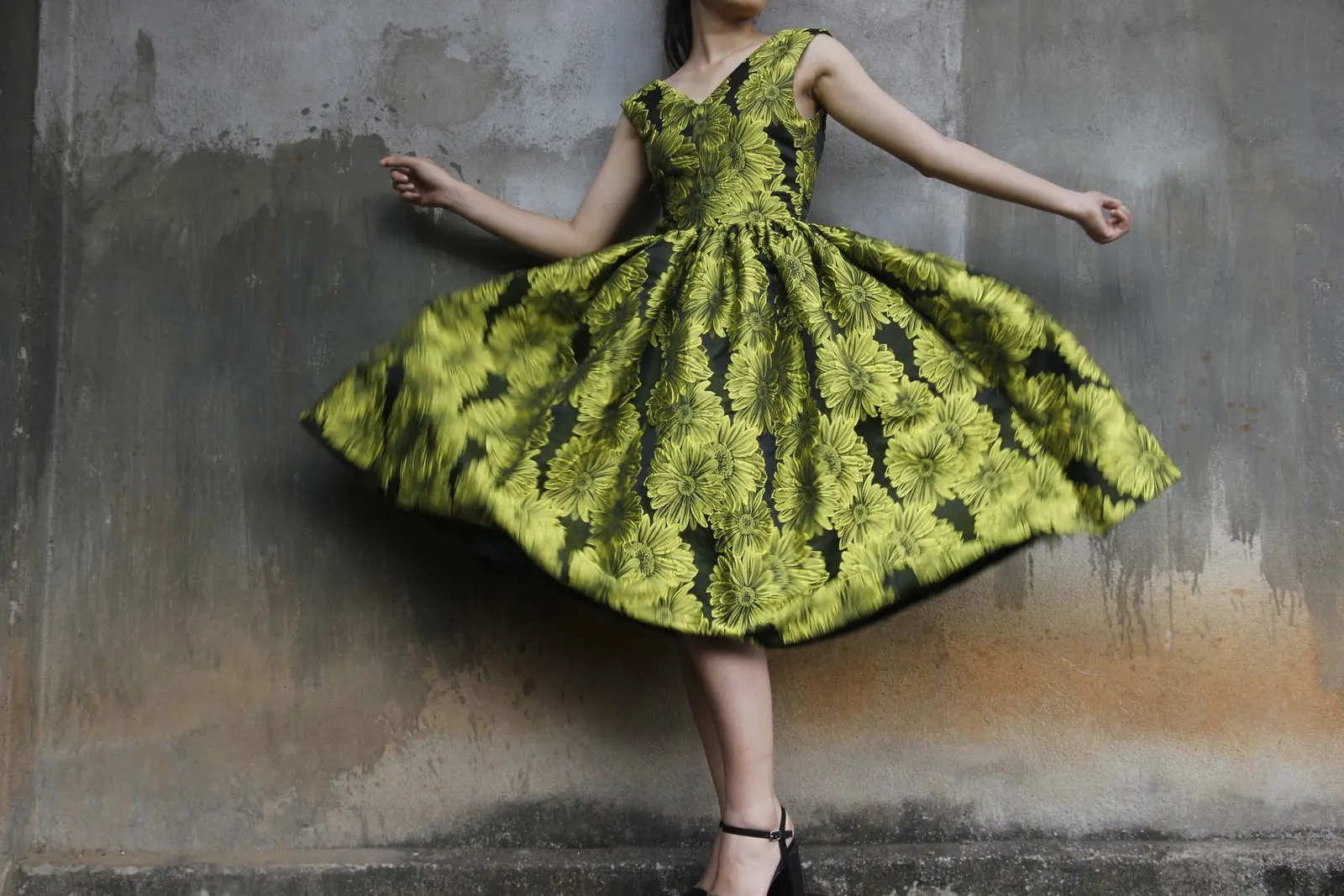
When a trouser has a wide hem, choose a shoe that can carry the width. When a skirt has a lot of volume, a finer shoe can keep the bottom from looking heavy. When the outfit is very simple, a strong shoe can be the statement.
Comfort is part of proportion. If you cannot walk naturally, the line will change as soon as you leave the house. Choose a shoe height you can repeat, then hem the garment to that height.
One statement is usually enough
The most reliable accessory outfit has one main event: a strong bag, an architectural earring, a vivid scarf or a sculptural shoe. The other pieces support it without trying to compete.
That does not mean everything else has to be boring. It means the hierarchy should be clear. If the outfit already has a bold print, a large collar and a dramatic sleeve, the best accessory may be a small, quiet one that lets those decisions speak.
Try every accessory in front of a full-length mirror rather than from the waist up. Proportion is a full-body question. The piece that works best in a close-up may be the one that makes the whole outfit feel unbalanced.
Related reading: Bold Print, Simple Line and Colour as a Fit Tool.